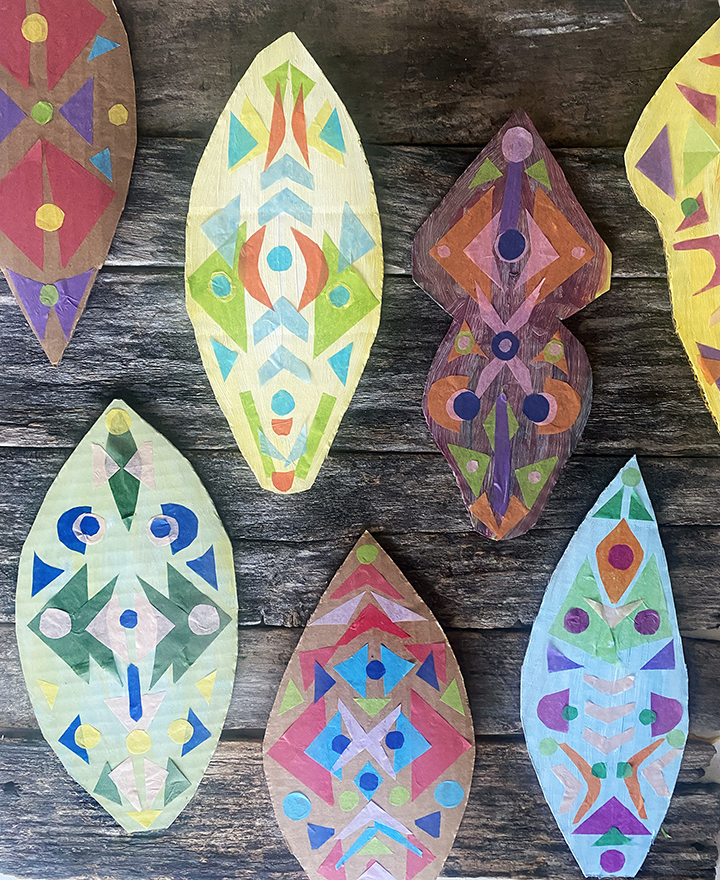
Need a simple, fun craft for a variety of ages? Make cocoon art! This is great for classrooms because they look stunning en masse, but is just as fun for a family afternoon. Supplies are minimal and inexpensive. While it was designed for elementary aged kids, there is no reason older students couldn’t enjoy it as well. They may even think of interesting ways to make it more complex. In fact, a group of adults might enjoy this craft as well!
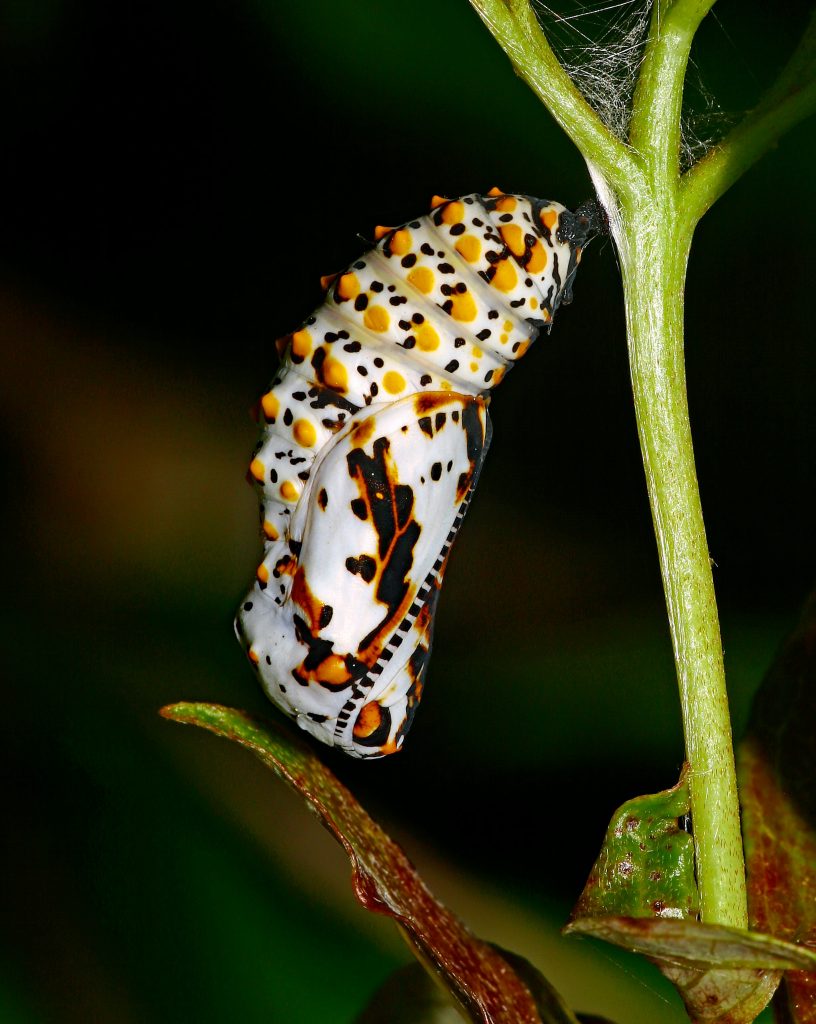
Start this project by looking at some examples of real chrysalis/ cocoons that critters make– the real thing is absolutely amazing and completely inspiring. Artists like Levon Biss and the Caterpillar Lab are great places to start. This is a great project to work on after learning about butterfly/ moth life cycles, cocoons and chrysalises, and (of course!) the importance of leaving the leaves!
This is also a fun way to learn some important art concepts like:
- Symmetry: ask students to cut everything in pairs and imagine a line of symmetry down the center of the cocoon.
- Color Mixing/ Transparency: because tissue paper is transparent, you can make new colors by overlapping pieces of different colors.
- Shapes: depending on age level, ask students to work with specific shapes and interaction of different shapes.

Differentiation & Notes
If you are doing this project with littles, you may want to use pre-cut shapes instead of letting them cut their own. For the youngest friends consider self adhesive foam shapes that will cut down on some frustration.
You can paint the cardboard or leave it brown. You can even use the paint in place of glue if you work fast.
For younger friends working on hand eye coordination, tweezers can be a fun way to work with the shapes.
Art Standards
Pre Kindergarten: VA:Cr1.1.PKa Engage in self-directed play with materials.
Kindergarten: VA:Cr1.1.Ka Engage in exploration and imaginative play with materials.
1st Grade: VA:Cr1.2.1a Use observation and investigation in preparation for making a work of art.
2nd Grade: VA:Cr2.3.2a Repurpose objects to make something new.
3rd Grade: VA:Cr1.1.3a Elaborate on an imaginative idea
4th Grade: VA:Cr2.1.4a Explore and invent art-making techniques and approaches.
5th Grade: VA:Cr1.2.5a Identify and demonstrate diverse methods of artistic investigation to choose an approach for beginning a work of art.
Multidisciplinary Standards
Kindergarten
NGSS
K-LS1-1 Use observations to describe patterns of what plants and animals (including humans) need to survive.
K-ESS3-3. Communicate solutions that will reduce the impact of humans on the land, water, air, and/or other living things in the local environment. (leave the leaves!!!)
ESS3.C: Human Impacts on Earth Systems Things that people do to live comfortably can affect the world around them. But they can make choices that reduce their impacts on the land, water, air, and other living things.
Common Core ELA
Common Core Mathematics
CCSS.Math.Content.K.G.A.1 Describe objects in the environment using names of shapes, and describe the relative positions of these objects using terms such as above, below, beside, in front of, behind, and next to.
CCSS.Math.Content.K.G.A.2 Correctly name shapes regardless of their orientations or overall size.
CCSS.Math.Content.K.G.B.5 Model shapes in the world by building shapes from components (e.g., sticks and clay balls) and drawing shapes.
CCSS.Math.Content.K.G.B.6 Compose simple shapes to form larger shapes. For example, “Can you join these two triangles with full sides touching to make a rectangle?”
1st Grade
NGSS
1-LS1-2. Read texts and use media to determine patterns in behavior of parents and offspring that help offspring survive.
LS1.B: Growth and Development of Organisms Adult plants and animals can have young. In many kinds of animals, parents and the offspring themselves engage in behaviors that help the offspring to survive.
Common Core ELA
CCSS.ELA-Literacy.RI.1.10 With prompting and support, read informational texts appropriately complex for grade.
Common Core Mathematics
CCSS.Math.Content.1.G.A.1 Distinguish between defining attributes (e.g., triangles are closed and three-sided) versus non-defining attributes (e.g., color, orientation, overall size); build and draw shapes to possess defining attributes.
CCSS.Math.Content.1.G.A.2 Compose two-dimensional shapes (rectangles, squares, trapezoids, triangles, half-circles, and quarter-circles) or three-dimensional shapes (cubes, right rectangular prisms, right circular cones, and right circular cylinders) to create a composite shape, and compose new shapes from the composite shape.
2nd Grade
NGSS
Structure and Function The shape and stability of structures of natural and designed objects are related to their function(s).
2-LS4-1. Make observations of plants and animals to compare the diversity of life in different habitats.
Common Core ELA
CCSS.ELA-Literacy.W.2.7 Participate in shared research and writing projects (e.g., read a number of books on a single topic to produce a report; record science observations).
CCSS.ELA-Literacy.W.2.8 Recall information from experiences or gather information from provided sources to answer a question.
Common Core Mathematics
CCSS.Math.Content.2.G.A.1 Recognize and draw shapes having specified attributes, such as a given number of angles or a given number of equal faces.1 Identify triangles, quadrilaterals, pentagons, hexagons, and cubes.
3rd Grade
NGSS
3-LS1-1. Develop models to describe that organisms have unique and diverse life cycles but all have in common birth, growth, reproduction, and death. [Clarification Statement: Changes organisms go through during their life form a pattern.]
Similarities and differences in patterns can be used to sort and classify natural phenomena.
3-LS4-4. Make a claim about the merit of a solution to a problem caused when the environment changes and the types of plants and animals that live there may change.
LS4.D: Biodiversity and Humans Populations live in a variety of habitats, and change in those habitats affects the organisms living there.
Common Core ELA
CCSS.ELA-Literacy.RI.3.3 Describe the relationship between a series of historical events, scientific ideas or concepts, or steps in technical procedures in a text, using language that pertains to time, sequence, and cause/effect.
Common Core Mathematics
CCSS.Math.Content.3.G.A.1 Understand that shapes in different categories (e.g., rhombuses, rectangles, and others) may share attributes (e.g., having four sides), and that the shared attributes can define a larger category (e.g., quadrilaterals). Recognize rhombuses, rectangles, and squares as examples of quadrilaterals, and draw examples of quadrilaterals that do not belong to any of these subcategories.
4th Grade
NGSS
4-LS1-1. Construct an argument that plants and animals have internal and external structures that function to support survival, growth, behavior, and reproduction.
LS1.A: Structure and Function Plants and animals have both internal and external structures that serve various functions in growth, survival, behavior, and reproduction.
Common Core ELA
Common Core Mathematics
CCSS.Math.Content.4.G.A.2 Classify two-dimensional figures based on the presence or absence of parallel or perpendicular lines, or the presence or absence of angles of a specified size. Recognize right triangles as a category, and identify right triangles.
CCSS.Math.Content.4.G.A.3 Recognize a line of symmetry for a two-dimensional figure as a line across the figure such that the figure can be folded along the line into matching parts. Identify line-symmetric figures and draw lines of symmetry.
5th Grade
NGSS
5-LS2-1. Develop a model to describe the movement of matter among plants, animals, decomposers, and the environment.
LS2.B: Cycles of Matter and Energy Transfer in Ecosystems Matter cycles between the air and soil and among plants, animals, and microbes as these organisms live and die. Organisms obtain gases, and water, from the environment, and release waste matter (gas, liquid, or solid) back into the environment.
5-ESS3-1. Obtain and combine information about ways individual communities use science ideas to protect the Earth’s resources and environment.
ESS3.C: Human Impacts on Earth Systems Human activities in agriculture, industry, and everyday life have had major effects on the land, vegetation, streams, ocean, air, and even outer space. But individuals and communities are doing things to help protect Earth’s resources and environments.
Common Core ELA
CCSS.ELA-Literacy.SL.5.5 Include multimedia components (e.g., graphics, sound) and visual displays in presentations when appropriate to enhance the development of main ideas or themes.
Common Core Mathematics
Cocoon & Chrysalis Art
Materials:
- cardboard
- tissue paper, various colors
- craft paint
- glue sticks
Tools:
- scissors
- paintbrushes
- tweezers (optional, see note)
Method:
First use scissors to cut cocoon shaped pieces from cardboard. You can make them all the same, or vary them. If you are working with younger kids, an adult may want to do this in advance.
Next, use foam brushes and craft paint to paint the cocoons. You want mostly solid colors so that the tissue paper is the star. You can also leave them brown if you prefer.
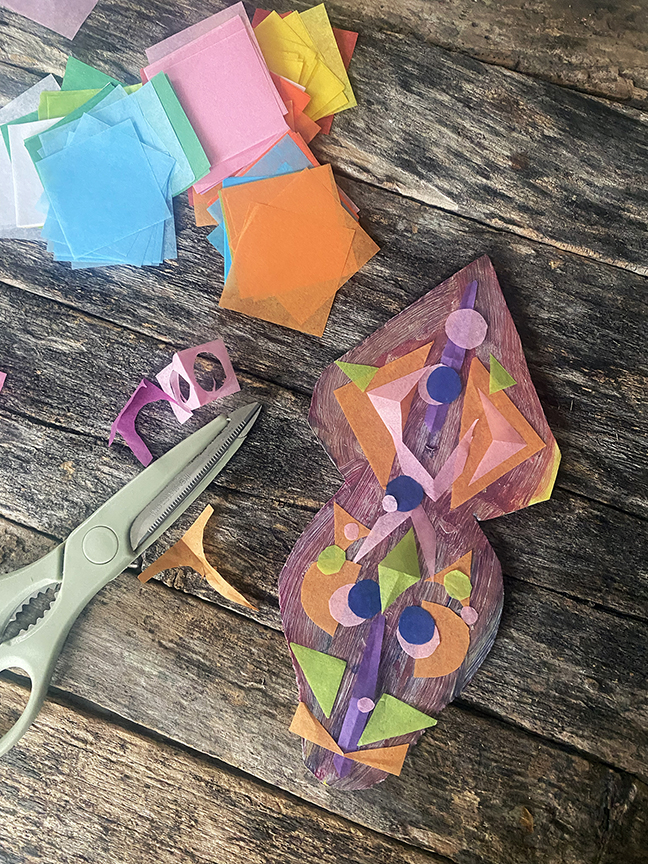
While the paint is drying, start cutting shapes from tissue paper. Fold the tissue paper in half or in quarters so that you cut more than one of each shape. Practice cutting geometric and organic or irregular shapes.
Have students identify the line of symmetry down the center of their cocoon and experiment with laying out the tissue paper shapes symmetrically.
Once the base is dry (or almost dry) Starting gluing down the shapes with a glue stick. Encourage students to overlap pieces and observe the color variations that creates.
Dry completely and display.